Friday, March 1, 2019

Kraft, Massage, and Human Trafficking

Cue the laugh track.
The world can’t stop chuckling at the news that New England Patriots owner Robert Kraft is one of the hundreds of men charged with soliciting prostitution at a so-called “massage parlor” in Florida. Even the Dinosaur Bar-B-Que got caught up in the fun, offering a special Jerked and Pulled Chicken Sandwich named after the dapper New Englander with the Super Bowl rings getting caught with his pants down. (Kraft denies the charges of solicitation.)
OK, guys. And I do mean guys -- have a good laugh. Then think about this. The illegal activity going on at the Orchids of Asia Day Spa in Jupiter, Florida, goes on all across the country, even here in Central New York. Sometimes it’s “just” prostitution, sometimes it’s worse – women trafficked and enslaved. The Polaris Project estimates that nearly 25 million people, most of them women, are coerced, threatened or otherwise forced into involuntary servitude worldwide. Tens of thousands of women are sex slaves in the United States.
Phony massage businesses, often referred to as “massage parlors,” are one of the covers that traffickers use to hide their crimes. Fortunately, New York state has the legal framework to put an end to this practice. Sadly, for generations, law enforcement has failed to act to enforce this protection.
Since 1968, New York has required that anyone practicing massage therapy must have a license from the New York State Education Department. The licensing exam, administered twice annually, can only be taken after completion of a 1,000-hour class at an accredited massage school. These regulations were passed in recognition of massage therapy’s beneficial health effects and to protect the public from unscrupulous and untrained people charging for massage. It also protects those of us in the profession from the stigma that has resulted from past association of the term “massage” (usually accompanied by a wink) with businesses selling sexual services for a fee.
This opens an avenue for law enforcement in New York to address possible trafficking in our community. Law enforcement need not charge an unlicensed spa or massage business with prostitution in order to shut them down. All they need do is ask one simple question – do you have a license? Some officials I have spoken with use the excuse that these places don’t call themselves “massage therapists”. They use terms such as “relaxation therapy” or “day spa.”
The objection is irrelevant. The law is clear. Anyone practicing any of the techniques used by massage therapists (and those techniques are spelled out in detail) without a license is subject to the licensing requirement. It is no more legal for someone to conduct massage without a license than it would be for me to pull teeth without a dental license. Even if I hang out a sign saying, “teeth puller,” I can’t pull teeth. That’s what dentists do.
The statute is clear. The need to protect the public and those who might be trafficked is urgent.
It’s time for law enforcement to stop treating this particular crime like a joke. Stop in to every spa and massage therapy practice in the county and ask to see the license. We’re happy to display ours. Every reputable spa, every Licensed Massage Therapist will be proud to show you their license.
The Polaris Project calls out the human traffickers and their patrons, calling their crime “Stealing Freedom for Profit.” What, I wonder, should we call law enforcement that fails to use this simple tool to find and root out this evil from our community?
It’s no joke.

Sunday, October 22, 2017

Saudi Beheadings Sanity 021415

AN UNCOMFORTABLE FOCUS ON HEADS OF STATE
by Ed Griffin-Nolan - Wednesday, February 4th, 2015
Michelle Obama appeared outfitted in a coat over a pant suit but nothing covering her head.


Last week, when President Barack Obama stopped in Saudi Arabia to pay his respects to the deceased King Abdullah, wags the world over went wild after first lady Michelle Obama appeared at the official welcoming ceremony outfitted in a flowing coat over her blue pant suit but nothing covering her head.
The men who run Saudi Arabia still require women to keep their heads wrapped up in a traditional headdress whenever they are seen in public.
President Barack and first lady Michelle Obama with Saudi King Salman bin Abdul-Aziz Al Saud, right,  after arriving in Riyadh, Saudi Arabia, Jan. 27, 2015. The first lady inspired blaring headlines and endless Internet chatter this week when she was photographed without headgear during the presidential visit to Riyadh, the capital of a conservative Muslim kingdom where women are compelled to cover their hair. (Stephen Crowley/The New York Times)
President Barack and first lady Michelle Obama with Saudi King Salman bin Abdul-Aziz Al Saud, right, after arriving in Riyadh, Saudi Arabia, Jan. 27, 2015. The first lady inspired blaring headlines and endless Internet chatter this week when she was photographed without headgear during the presidential visit to Riyadh, the capital of a conservative Muslim kingdom where women are compelled to cover their hair. (Stephen Crowley/The New York Times)
Michelle Obama’s decision was criticized by some as a diplomatic faux pas and praised by others as a statement on behalf of women’s rights.
There were lots of reasons for her not to cover up in Saudi Arabia. For starters, she has great hair. Then there is the possibility that she was making a statement that women shouldn’t be told by their rulers, especially unelected rulers, and most especially male rulers with a demonstrated lack of fashion sense, how to dress.
If the world’s most popular Obama was making a statement on behalf of women’s rights in Saudi Arabia, it would have been a bold move. Women in the petropatriarchal theocracy that sits on top of the world’s largest proven oil reserves are decidedly second-class citizens. They cannot vote (not that voting in the kingdom matters much for the men, either). They can’t drive. They can’t even go out of the house without a man’s permission.
And there’s this: The Saudi women, like most male Saudis, don’t seem to complain much. Most native Saudis are content to collect their share of their ruler’s oil largesse in exchange for silence.
The White House sidestepped suggestions that the first lady was making a statement, instead noting the she was following protocols set by her predecessors. Oh, yes, and did we mention that the sheiks are sitting on an ocean of oil? Every U.S. president going back to the Second World War has made a point of sucking up to the Saudi monsters.
But Obama’s hypocrisy stands out even among the long line of American leaders who have worshipped at the altar of Saud. As commander-in-chief of the war on beheadings, Obama’s choice to prominently pay homage to the throne shocks the sensibilities. In the post-9/11 world, we have all grown used to leaders justifying the alliances they draw us into on the basis of expediency, but surely Obama knows that when it comes to beheadings, the Saudis are the unrivalled champions of the Middle East. ISIS head choppers are amateurs compared to the Saudi executioners.
In a recent four-year period, the Saudis executed 345 people, every one of them in public, and the method of execution was beheading. That’s about the same number of beheadings carried out by ISIS in its terror campaign in Syria and Iraq.
In what turned out to be his last year on the throne, King Abdullah had 87 people executed — most for drug-related offenses, a few for religious crimes that included apostasy and sorcery, others for daring to voice opposition to the despots who rule them.
ISIS has earned the disgust of the world. Obama righteously denounced the hideous YouTube beheadings by ISIS as “pure evil.” Yet on the very day he paid his respects to the Saudi monarch, three men were beheaded in the kingdom of the man he chose to praise.
Given that the president couldn’t even be bothered to suggest to the Saudis that they stay their hand for even a day, it’s a sure bet the White House was happy to have all the attention focused on the first lady’s uncovered, intact head.

RealPolitik

FDR in 1933
FDR in 1933
President Franklin Roosevelt was reported to have once said about his Central American ally, the Nicaraguan dictator Anastasio Somoza, “He’s a son of a bitch, but he’s our son of a bitch.”
At least Roosevelt gets points for honesty.
We can all understand why the U.S. has kissed the Saudi’s sandy posterior all these many years. But does the Department of Defense really have to sponsor an essay contest in his honor?
The king was barely in the ground when Gen. Martin Dempsey, chairman of the Joint Chiefs of Staff, announced that the National Defense University was creating “an important opportunity to honor the memory of the king, while also fostering scholarly research on the Arab-Muslim world.”
“I found the king to be a man of remarkable character and courage,” said Dempsey, according to a news release from the Pentagon.
The essay contest will allow students at the National Defense University to honor the king’s legacy by encouraging “strategic thinking and meaningful research on a crucial part of the world.”
And who can argue with that?
***
Ed Griffin-Nolan is a journalist who believes we have to ask the hard questions no matter whose interests are at stake. Sanity Fair is his weekly take on life, politics and society.
Ed Griffin-Nolan

Use Facebook to comment on this post

A burst of cruelty

Just six weeks back Ellen and Dia and I stopped  on a sand track along the Chobe river, shut off the engine our Toyota pickup truck and watched as a herd of elephants twice the size of our vehicle passed quietly to our right. It was a scene that will remain forever in my memory, as the creatures who are literally mammoth in size lumbered past us. Only a few of the males bothered to look up, turning their trunks and giant heads toward, eyeing us to make sure we knew they were there.

They left us to sit there undisturbed, to marvel at their massive, mobile beauty, to enjoy their family outing. At one point, later in the day, I counted 74 elephants crossing in front of us.

We knew that a momentary burst of cruelty, or fear - or anything really -  on their part could kill the three of us. These African bush elephants weigh as much as six tons each, and there were dozens of them.

But there in the Chobe National Park in northern Botswana, hunting is banned, poaching is contained by police action, and the elephants, accustomed to visitors with binoculars, left us alone.

Two days ago we learned from a friend in Botswana that more than two dozen of the elephants on the Chobe had been killed by raiding poachers. The invaders, most likely from across the river in Namibia, cut the faces from the grass eating elephants, who flock to the Chobe by the hundreds in search of water. They cut off their trucks and amputated their tusks, which are like gold in some markets.

In an instant, Chobe, the sole safe and wild sanctuary for wildlife in southern Africa, was violated and changed forever.

Horse sense


This post is about #MeToo. This is not about me. It starts with a horse, but bear with me, because it ends with a serious proposal to stop sexual harassment and assault in the entertainment industry.

In a 1939 Henry Fonda movie, Jesse James, a horse was pushed off a cliff. The horse survived the fall, but got a bit flustered and drowned shortly thereafter. If you are horrified, you should be. Many people were, and the film industry was forced to accept outside supervision of any animals used on set. The Humane Association has ever since kept on eye on the non-human actors and provided the filmmaker with the seal of approval pictured above.

(Does it work? Not always)

Now we have learned  of (or now we have been forced to stop denying), powerful men in the film industry routinely use that power to obtain sexual favors from women. It is not just Harvey Weinstein. It's endemic. My question is - if the death of one horse led to an industry wide enforceable ban on a vile practice, why shouldn't the violations wreaked upon dozens of women by Weinstein lead to a similarly enforceable ban on his nasty practice?

My proposal is simple - an outside human rights group, presumably including lawyers, would verify that they monitored the filming of the movie (or TV show), and that no woman was harmed in the making of it. To ascertain this, the lawyers would interview every woman involved in the project under veil of anonymity. Any scoundrels would be prosecuted or banned, or the label would not be attached to the film. That would leave the producers with some 'splainin to do.

Why not give it a try? They saved horses, didn't they?

Sunday, April 9, 2017

Clear Eyes over Syria


The US military, following orders of the 45th President, did something in Syria this week. Lots of people were heard to say, “finally”. The Commander-in-Chief who boasts he has never changed a diaper grieved publicly for the lost Syrian children who died slow deaths choking on sarin gas. “No child of god should have to suffer such harms.” A statement no one save atheists can argue with.

You might be tempted to see this as a rupture with the recent past, but if we listen carefully we will see not a break with the 44th President’s policy, but rather continuity. The current administration, like its predecessor, is reacting not to the generalized horror of the Assad regime’s assault on its people, but on its use of this specific horror – chemical weapons. Since World War I, with few and notable exceptions, the world has agreed that chemical weapons should not be deployed.
When Assad used these poisons in 2013, the previous administration reacted. We’ve grown so accustomed to hearing the chorus saying that Obama did “nothing” at the time. Which is only because in the minds of too many in the media and among conventional thinkers in both parties, you are doing “nothing” unless you are doing “something” that involves weapons.
The previous administration did react. Here is what they did: they forced Syria to sign a treaty against the use of chemical weapons, charged Russia with removing and destroying them, and put the force of the United Nations behind that sentiment.
That action, frequently described by commentators and hawks as “doing nothing” worked for four years. Four years without a chemical attack in this war – if I were a Syrian family trying to stay alive, I would take that. Four years to find safe haven, to find more effective means of resistance, four years to stay alive. I would take that. Call it what you will, it’s not nothing.
Enter 45. Assad attacks Idlib with chemical weapons, probing to find out if the current President really means what he said in 2013, that this was not really our concern, and that we should stay out. Assad learned when the US launched the 59 missiles that destroyed his 20 planes and shut down his airfield for 24 hours, that the ban on chemical weapons - a red line, if you will – was still in effect.
Both actions – Obama’s diplomacy, Trump’s gunplay – have the same result. They remind Assad that there is no percentage in using these particular weapons. And that is, by any realistic standpoint, about all we can do in this situation (that plus open our doors to those who flee).
The partisan bickering that goes on just masks this fundamental consistency. If you needed any more proof of continuity you should watch Hillary Clinton, hours before the Tomahawks flew, egging on the man who she beat by 3 million votes in November to rev his engines.
The good news in all, a sanity within the unbearably painful insanity of this conflict, is that both administrations seem to recognize limits. There is little that we can do to end this war, short of sending an army as populous as the city of Miami to spend decades in Damascus, and so every day we stay away, and every day that chemical weapons remain in their sheaths, is what passes for a good day.

Sigh.

Friday, September 30, 2016

Happy Botswana Independence Day, Everyone

Happy Botswana Independence Day, Everyone!


Across the Atlantic Ocean, in a dusty village south of the Tropic of Capricorn, a few hours from the border with South Africa, our daughter Dia has been up all night with her neighbors singing and praying and cooking, as apparently most of Botswana’s two million people are doing, to celebrate fifty years of independence.
Botswana isn’t a place you hear of much in the news. It’s a big country, about the size of Texas. It’s very sparsely populated, and a lot of it is given over to the forbidding Kalahari desert. It’s got the largest inland delta in the world (two years ago I didn’t even know there were such things), and the most numerous elephant herd of any country in the world.
On the subject of elephants - Paul Allen, who founded Microsoft along with Bill Gates, recently paid for a crew of scientists to fly small planes all over Africa and count elephants, and his Great Elephant Census reports that there are about 130,000 elephants in Botswana.
I don’t have Paul Allen’s money, but we did go to Botswana earlier this year, and one afternoon I stopped our pickup truck on a dusty sand track near the Chobe River because an elephant had just emerged from the bush right in front of us. I shut off the engine (the only prudent response when a six-ton mammal lumbers anywhere in your general direction). Then I began to count.
Seventy four.
Seventy four elephants paraded in front of us on their way to the river that morning. That is a lot of elephants. In Botswana the elephant herd is growing – and that’s not the only thing. The preservation of wildlife has made the country a magnet for tourists around the world, a boom that employs one in every 20 working age Batswana (that’s what you call a citizen of Botswana).
Driving around Botswana (the highways are modern even by US standards) you see a country undergoing rapid growth. Stopping for breakfast in a chain restaurant in Francistown, the first thing the waitress asked me was if I wanted the wi-fi code. (Sure, I said, but mostly I needed coffee – the Bats do not share my addiction to caffeine). As we drove from Dia’s village back to the capital of Gabarone, (a city without stoplights as recently as 1989) a colleague of hers told us that the four-hour trip, again along a splendid highway, would have taken 10 or 12 hours just a few years back.
Botswana has some advantages that other post-colonial African nations do not. Landlocked and sparsely populated, it was not considered a prize by predatory European colonists, who preferred to pounce on South African and Namibian mines and coastland. Botswana asked to become a British protectorate in the early 20th century, and then dissolved the pseudo-colonial relationship with a handshake fifty years ago.
A year later they discovered the diamonds. It was like finding a winning lottery ticket in your pockets as you sort laundry.
The first President, Seretse Khama (whose two sons now serve as President and Minister of Tourism) had been disowned by his own tribe when he married a white British woman. Khama’s interracial marriage also greatly irritated apartheid South Africa. As a result, Khama set out to develop a national, not tribal, political base, and a multi-racial democracy. He let foreign companies bid on mining rights to the diamonds under terms favorable to Botswana, and invested the funds in public health, education and infrastructure. This served the country well and by the mid 1970’s Botswana was doing well enough to ask the Peace Corps to cease and desist in its development efforts.
Then came HIV. As many as one in four adults in Botswana were infected in the early years of the epidemic. Life expectancy dropped from first world levels (65 years on average) to below 40 years. In 1995, a 15-year-old in Botswana had a 50% chance of dying from an AIDS related illness.
Botswana responded to the epidemic slowly at first, but in time adopted educational, treatment, and preventive measures that are considered models for other countries.
Since 2002 it has been policy for the government to make anti-retroviral medications available free of charge, and nearly 70% of those infected are receiving the life-saving drugs. And Dia’s work with the Peace Corps is a part of that effort, one that makes her mother and I smile with pride.
So tonight, if you hear dancing and singing late into the night in a tongue that only the most devoted non-natives can master (we hear that Dia has gotten very good at it!), raise a glass to Bots 50, a proud moment for a small country that is trying, against some pretty heavy odds, to do right by its people.


Friday, June 17, 2016

Obama "Directly Responsible" for Orlando Murders, says McCain

This used to the be image of the two wings of the Republican Party. Independent minded war hero John McCain of Arizona, and, to his right, Alaska governor Sarah Palin. McCain chose Palin to run with him in 2008 against Barack Obama in hopes of winning the votes of Republicans who felt he was too liberal, or too much of a "maverick" to earn their support.

I resist the urge to say that Palin was selected to win over more "conservative" voters, because I do not wish to dishonor legitimate conservatives. Palin was, and remains, a part of the growing sector of Republicans who portray themselves as conservatives but are in fact either lazy politicians allergic to facts or opportunists who build their careers on encouraging ignorance. That Palin lives and dies by this is no surprise - her inability or unwillingness to think things through even got her fired from Fox News, no small feat. Some call it "shooting from the hip", which Donald Trump has elevated to an art form. President Obama called it "making stuff up", which I second, substituting a shorter and stinkier S word.

The news is that Palin's former running mate, the senior Senator from Arizona, a man whose name is half the moniker for our one standing piece of campaign finance reform (McCain-Feingold), has joined the fringe. As if Donald Trump's victory in the Republican primary process was not enough to convince us, John McCain's surrender to the fantasy land created by Fox News and nurtured by folks like Palin confirms - the moderate wing of the Republican party is dead.

McCain yesterday called President Obama "directly responsible" for the massacre in Orlando. Then a few hours later he mentioned that he "misspoke". Misspoke? Misspeaking is when you get the capital of Ohio wrong, it's when you confuse the budget deficit with the national debt, it might even be when you say, as Donald Trump did, that the murderer who shot up the Pulse nightclub was born in "Afghan", wherever that is.

When you call the sitting President an accomplice to mass murder at the very moment he is consoling the survivors, that is no misstatement. It is a clear statement of McCain's beliefs. And his core belief is this - that without the support of the crazy people in his party, he cannot win his sixth term in the Senate. Eight years ago a similar calculus pushed him to pick Palin, but we had the good sense to kick her to the curb. Whatever once passed for decency and common sense even among principled conservatives is no longer viable in the age of Trump.

Don't be confused by McCain's subsequent apology for his misstatement. All he needs is that tape of himself blaming Obama to serve up as red meat to the lunatic fringe, while the mainstream media allows him to "walk back" his story.

And all the rest of us are left to do is to watch as the party of Lincoln and Rockefeller, Jacob Javits and Dwight Eisenhower, tumble into incoherent rambling divorced from the truth and the serious business of running a country.

Wednesday, June 8, 2016

Bernie Fans, Is this just a campaign, or is it a movement?


What happens next will tell us if Sanders supporters are in this for the long haul, or just along for the ride.


I voted for Bernie Sanders.  He stands for most of the things I’ve stood for my whole life. A foreign policy that respects other countries. Domestic policies that put the poor and working class first. Addressing climate change with the urgency that this aching planet demands. He is demonstrably the candidate who understands these issues best and has the commitment to address them. Whether that means he would make the best President is an open question, but I voted for him on the issues.
Now that his fight for the nomination has failed, his supporters have a choice to make. We can howl that the process is rigged (pointless), we can vilify Clinton as a Wall Street lackey (yawn), or we can act as if we actually believe the words and the example of Bernie Sanders.
I’m not talking only about the Bernie Sanders who enchants with his straight talk, who pals around with Pope Francis, who charms tiny sparrows. I’m talking about the Bernie Sanders who has spent a lifetime as part of a movement for social justice, a pursuit that has always been secondary to his personal political aspirations.
The choice for Sanders’ supporters will be whether we can transform the organization and the energy of the campaign into a lasting movement. It will be about whether the Sanders’ followers, often criticized for being too young and too idealistic, can show the Democratic establishment and the rest of the country, that we are serious about radical change. We have to decide if we are in this to feel good, or to do good. (We also have to make sure that those in our ranks understand that we will be paying for the changes we hope to bring about – no small task).
Real change, as Sanders points out relentlessly, can only begin when we remove money from its central role in our politics. Sanders’ campaign, funded by folks with twenty-seven dollars to spare, nearly propelled him to the nomination. Now we must unite behind the Clinton candidacy from now until November, and, come January, be prepared to push her to uphold the campaign promises that Sander’s movement has forced her to make.

We will have to hold President Clinton’s feet to the fire on campaign finance reform. Every change that progressives hope to see is dependent on serious campaign finance reform, an end to what Sanders rightly calls a corrupt system and which many of us see as legalized bribery. No one has articulated this issue more clearly than Sanders. It is the key to returning power to the people and not just the people who can afford it. Overturn Citizens United. Banish the notion that corporations are people. Provide public financing for campaigns, and let ideas, not fund raising power, lead our public discourse.
It’s not an idea that we can let die just because more Democratic primary voters chose Hillary Clinton, with her ties to big money, as their candidate for President. It is far too important.
But how can a defeated Sanders hold sway over his one-time opponent’s policies? As Vice President, as some of his supporters suggest? Worst idea ever. Why lock Sanders away in the White House when he could be in the Senate and out in the country campaigning for change? Sanders has laid the groundwork for a movement that combines support for progressive causes, and support for progressive candidates with a fundraising power that can rival a Super Pac. Imagine a movement sweeping into key Congressional districts and swing states to turn out voters and flip some key Congressional seats this fall. Imagine what that movement could do in 2018 with a similar strategy.

Can Sanders’ supporters make this adjustment? Presidential candidates have tried to convert their campaigns into movements before. Jesse Jackson’s Rainbow Coalition comes to mind; President Obama’s Organizing for America group was somehow supposed to keep the grassroots involved even as their man sat in the Oval Office. Usually they end up as top down entities serving their leadership, and they peter out or lose relevance.
This time it could be different, because of the type of campaign he ran.
Many of the Sander’s troops seem to so enjoy vilifying Clinton that it makes unity seem unlikely. But a united Democratic Party this fall could open the door to progressive changes no one was even talking about before the Sanders surge. All because of the campaign he ran. A mature movement would recognize its victory even while conceding the failure of their Presidential campaign.
Clinton devotees must recognize that they will not win over the Sanders’ voters by simply noting that she is the lesser of two evils. We have heard that lullaby too many times. They must fully recognize that Bernie’s brigade not only rejects the triangulation politics that made the Clintons so successful in the 90’s, but that they are speaking to the concerns of a new generation.

A friend of mine who loves Bernie posed a common complaint – he just doesn’t trust Clinton. That is an excellent first step. Our political system is not based on trust. If we think our job is to vote once every four years and then let the elected run the country, we have misunderstood what it is to be a citizen of a democracy. We should not trust any politician to do anything other than what we have to power to make them do. Barack Obama in meeting with a group of environmentalists early in his first term was reported to have quoted FDR to them. “I agree with you. Now make me do it.”

If Hillary Clinton is our next President, Bernie Sander’s aroused following don’t have to like her or trust her. As Sanders has made clear, his political revolution is not solely about deciding who sits in the Oval Office. It really is about mobilizing the millions who have rallied to his cause, and then continuing to organize pressure that will keep a progressive agenda on track.


Wednesday, April 20, 2016

Decision Time for Those Who Are Feeling the Bern

Is this a movement, or a campaign?
What happens on Wednesday will tell us if Sanders supporters are in this for the long haul, or just along for the ride.


I’m voting for Bernie.  He stands for most of the things I’ve stood for my whole life. A foreign policy that respects other countries. Domestic policies that put the poor and working class first. Addressing climate change with the urgency that this aching planet demands. He is demonstrably the candidate who understands these issues best and has the commitment to address them. Whether that means he would make the best President is an open question, but I’m voting for him on the issues.
If Bernie doesn’t win  (and there is, no one can argue, at least a 50/50 chance that he won’t), his supporters have a choice to make. We can howl that the process is rigged (pointless), we can vilify Clinton as a Wall Street lackey (yawn), or we can act as if we actually believe the words and the example of Bernie Sanders.
I’m not talking only about the Bernie Sanders who enchants with his straight talk, who pals around with Pope Francis, who charms tiny sparrows. I’m talking about the Bernie Sanders who has spent a lifetime as part of a movement for social justice, a pursuit that has always been secondary to his personal political aspirations.
The choice for Sanders’ supporters will be whether they can transform the organization and the energy of the campaign into a lasting movement. It will be about whether the Sanders’ followers, often criticized for being too young and too idealistic, can show the Democratic establishment and the rest of the country, that we are serious about radical change. We have to decide if we are in this to feel good, or to do good. We also have to make sure that those in our ranks understand that we will be paying for the changes we hope to bring about – no small task.
Real change, as Sanders points out relentlessly, can only begin when we remove money from its central role in our politics. Sanders’ campaign, funded by folks with twenty-seven dollars to spare, just might propel him to the White House. If it does not, it must unite behind the Clinton candidacy from now until November, and come January be prepared to push her to uphold the campaign promises that Bernie has forced her to make.

That has to begin with vigorous support for grassroots efforts to promote public financing for campaigns. No one has articulated this more clearly than Sanders. It is the key to returning power to the people and not just the people who can afford it. Overturn Citizens United. Banish the notion that corporations are people. Provide public financing for campaigns, and let ideas, not fund raising power, lead our public discourse.
This should be the first course of action for a Sanders’ Presidency, or the first challenge that the Sanders’ movement lays at the feet of a President Clinton. Sanders has laid the groundwork for a movement that combines support for progressive causes, and support for progressive candidates with a fundraising power that can rival a Super Pac. Imagine a movement sweeping into key Congressional districts and swing states to turn out voters and flip some key Congressional seats this fall. Imagine what that movement could do in 2018 with a similar strategy. Let’s call it a People’s PAC.
Can Sanders’ supporters make this adjustment? Presidential candidates have tried to convert their campaigns into movements before. Jesse Jackson’s Rainbow Coalition comes to mind; President Obama’s Organizing for America group was somehow supposed to keep the grassroots involved even as their man sat in the Oval Office. Usually they end up as top down entities serving their leadership, and they peter out or lose relevance.
Many of the Sander’s troops seem to so enjoy vilifying Clinton that it makes unity seem unlikely. But a united Democratic Party this fall could open the door to progressive changes no one was was even talking about before the Sanders surge. A mature movement would recognize its victory even while conceding the failure of their Presidential campaign.
Clinton devotees must recognize that they will not win over the Sanders’ voters by simply noting that she is the lesser of two (or more) evils. We have heard that lullaby too many times. They must fully recognize that Bernie’s brigade not only rejects the triangulation politics that made the Clintons so successful in the 90’s, but that they are speaking to the concerns of a new generation.

A friend of mine who loves Bernie posed a common complaint – he just doesn’t trust Clinton. I thought that was a good first step. We should not trust any politician to do anything other than what we have to power to make them do. Barack Obama in meeting with a group of environmentalists early in his first term was reported to have quoted FDR to them. “I agree with you. Now make me do it.”

If Hillary Clinton is our next President, Bernie Sander’s aroused following don’t have to like her or trust her. As Sanders has made clear, his political revolution is not solely about deciding who sits in the Oval Office. It really is about mobilizing the millions who have rallied to his cause, and then continuing to organize pressure that will keep a progressive agenda on track.


Saturday, June 27, 2015

David's Law Sanity 012815

LAWMAKERS IN ALBANY NEED DAVID’S LAW
by Ed Griffin-Nolan - Wednesday, January 28th, 2015
(This may or may not be an exclusive)
A lawyer friend of mine says that whenever a law is named for someone, you can pretty much figure that it’s a bad law.
I generally agree with my friend the attorney, but after the indictment of Assembly Speaker Sheldon Silver, I’m willing to make an exception this time and offer the following suggestion: The New York State Legislature, or at least the unindicted remnant of its members, should pass David’s law, named in honor of Oneida’s own Sen. David Valesky, a six-term Democrat who belongs to the Independent Democratic Conference, a tiny band of legislators who have hopes of being the swing votes in the state Senate and pushing a reform agenda.
Sen. Dave Valesky Michael Davis Photo | Syracuse New Times
Sen. Dave Valesky
Michael Davis Photo | Syracuse New Times
Valesky is unashamed to admit in public, and to verify in writing on his financial disclosure forms, that he moonlights as the accompanist playing the organ at the Catholic church where he grew up and where his family attends Mass most Sundays. The disclosure forms say he is paid less than $5,000 for this service, but the senator himself once told me the exact amount is $500. (This may or may not be an exclusive.)
In the wake of the allegations that Silver collected millions of dollars in bribes disguised as legal work, it seems evident to me that the time has come to finally force our legislators to do the job we hired them to do and to knock off this moonlighting.
Legislating and serving one’s constituents is a full-time job, and it should be treated as such. Gov. Andrew Cuomo, in his State of the State speech one day before the Silver bombshell, seemed to acknowledge as much. The governor suggested a pay cut for any legislator who moonlights.
In this space, you have been hearing for years a simpler and more radical proposal:  In exchange for the privilege of representing us (and the ample salary and perks we bestow upon them), our state legislators should be mandated to forego outside income.
Except that would deprive the good people of St. Patrick’s parish in Oneida of the valued services of Mr. Valesky. Not wishing to force a sanctuary filled with worshippers to sing a cappella, let us adopt the following compromise: No one in the Assembly or Senate is allowed to earn more outside income than Dave Valesky. If the parish gives him a raise, the whole Albany bunch can up their take by just as much.
In the meantime, let’s remind them: They work for us, and not the other way around.

Je Suis Abdullah?

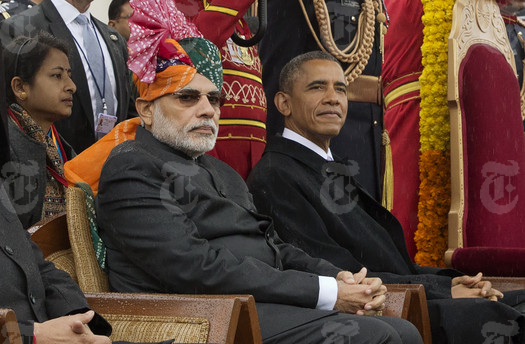
President Barack Obama and Indian Prime Minister Narenda Modi watch a parade and award ceremony during India's Republic Day celebration in New Delhi on Jan. 26.
President Barack Obama and Indian Prime Minister Narenda Modi watch a parade and award ceremony during India’s Republic Day celebration in New Delhi on Jan. 26.
President Barack Obama, who skipped the Paris march of world leaders in support of freedom of expression after the Charlie Hebdo massacre by Islamic extremists, cut short his stay in India to pay his respects to the deceased king of Saudi Arabia, where blogger Raif Badawi has been publicly caned for publishing views challenging the Islamic extremists who run his country.
Obama’s obsequiousness to the Saudi kingdom (which, lest we forget, was home to 15 of the 19 men who attacked us on Sept. 11, 2011) is consistent with long-standing U.S. policy of ignoring the kingdom’s discrimination against women, lack of due process and its theocratic worldview while peddling armaments to the Saudis to the tune of nearly $86 billion over the past five years. That’s billion, with a “B.”

Gangster Oilmen

“Abdullah presided over one of the world’s most wicked nonpariah states, whose domestic policies are almost cartoonishly repressive and whose international influence has been strikingly malign. His dynasty is founded on gangsterish control over a precious natural resource, sustained by an unholy alliance with a most cruel interpretation of Islam and protected by the United States and its allies out of fear of worse alternatives if it fell.”
— Russ Douthat, columnist, New York Times
*

Micere Mugo Sanity 041515

MICERE MUGO’S TIRELESS PURSUIT
by Ed Griffin-Nolan - Wednesday, April 15th, 2015
Professor Mugo has served on the faculty of the African American studies Department at SU


Can you imagine a Syracuse without Micere Githae Mugo? Can you imagine if a giant walked in our midst, so quietly that we did not know it?
Micere Mugo’s many friends and colleagues gathered at Syracuse University on April 2 and 3 to paint a picture of a career and a life that has caused ripples to roll across generations and institutions and disciplines. She was honored as a playwright, literary critic, and a social and political activist who challenged colonial and neocolonial rule in Africa as bravely as she challenged racism here in Syracuse and around the United States. And she was saluted as a kind friend, an auntie and a tireless mother for the many younger women she brought under her wing.
For 22 years Mugo has served on the faculty of the African American Studies Department at SU. It is not enough to call her work interdisciplinary. In her writing and scholarship she shreds the lines between disciplines, nor is she bound by any line between academia and activism. She has been an adviser, a mentor, an activist, a role model, and, beginning as a young woman in East Africa, a pioneer in national liberation struggles and campaigner for human rights.
She has built a reputation based on hard work and relationships with students, colleagues and friends who were once strangers. When you meet her it is hard not to feel that you are in the presence of royalty, if royal status were not hereditary but instead earned by selfless service. “Can you imagine?” she would say.
Late last year word started to filter out from the SU Hill that Mugo would be retiring at the end of the spring semester, pushed by nagging health issues and pulled by a desire to spend more of her time in her native Kenya. Supporters across campus mobilized to prepare a proper tribute.
Then word spread to other campuses, here in the United States, then in Europe and the United Kingdom, and back home to Africa. By the time the event kicked off on April 2, 30 different university and community institutions and organizations were lined up to sponsor, dozens of academics competed for a chance to speak, artists and writers clamored to perform in her honor.
Micere Mugo
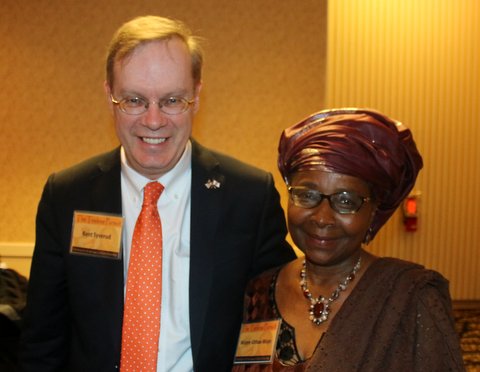
SU Chancellor Kent Syverud and Micere Mugo
Mugo’s celebration brought back former chancellor and good friend Nancy Cantor to the SU Hill for what may have been her first appearance since she left town a year ago. The tribute included music from the James Gordon Williams Trio (which includes bass player Bill Horrace, whose day job is chair of the Economics Department at SU), dance from several student and community groups, and readings from poets from Syracuse and around the world.
You would never think when listening to her gentle voice that the slight woman (as one participant put it, “rocking the African headdress”) had lived through exile, incarceration and threats in Kenya and abroad as a result of speaking against the dictatorship that ruled her country after independence. One play she wrote along with her Kenyan colleague Ngugi wa Thiong’o, entitled The Trial of Dedan Kimathi, a Mau Mau independence fighter, is considered a classic of political drama 40 years after it was first produced.
Mugo was lauded as a teacher and a mentor, a poet and a playwright, but also as an “auntie” to so many women, and a surrogate mom to many more. She was remembered as one who could gently prod her colleagues or her students to take risks and work harder.
The symposium in her honor was entitled “Tireless Pursuit” and the theme of Mugo’s seemingly boundless energy was raised again and again. She helped found the local organization United Women of Africa, the Ghana Society of Central New York, and the Pan African Community of Central New York.
Dean Diane Lyden Murphy said that Micere Mugo possesses “a moral compass for knowing the right thing to do and a talent for inspiring others to follow — gently.” Willy Munyoki Mutunga, who serves as the chief justice of Kenya’s Supreme Court, made the journey from Nairobi to Syracuse to discuss the topic, “Micere as the Mother of Feminist Masculinity.” He recounted a time in the 1970s when Mugo, then the mother of two small girls, was appointed the first female dean of a college at the University of Nairobi. In a meeting with her colleagues, he recalled, she began by mentioning that she had a question for her male counterparts: “Do you cook? Do you do your laundry? Do you change the nappies on your children?” She made her point.
Feature photo: Micere Mugo (left) with Linda Carty, professor in the African/African-American Studies Department  at Syracuse University. Alejandro Garcia photo.

Earth Day 2015 Sanity

CLIMATE CHANGES EARTH DAY PERSPECTIVE
by Ed Griffin-Nolan - Wednesday, April 22nd, 2015
What do we do to try to diminish our impact on global climate change?
Global warming should have a YouTube account. It should threaten beheadings, claim religious justification for its actions, and recruit a handful of our young ones to its cause. Then maybe we would start to fear it as much as we should.
Well, it worked for ISIS. The latest Middle Eastern terrorist boogey men, now in retreat across Iraq, certainly caught our attention. ISIS has managed to make us willing to expend all manner of national treasure, prestige and energy in the battle to exterminate them. Climate change that threatens our way of life? Not so much.
HomeUnderwaterWhile our behavior inexorably melts the glaciers, swamps our shorelines and multiplies the number of crazy weather events each year, it is the relatively remote but prominently publicized terrorist threat that has been the driving force for so many of our national policies. The terrorists have been able to harness the awesome power of fear, while the environmentalists cling tenaciously to a belief in the power of reason.
No contest.
If ISIS is Fox News, climate change is CNN. Or C-SPAN. Climate change moves too slowly, the science is too complicated, and there are too many parties too heavily invested in the status quo. It doesn’t help that the face most commonly associated with the cause is Al Gore, who seems too easy a target for mockery.
Even when climate change occasionally rears its head in a nasty way, as was the case with Hurricane Sandy, deniers were quick to dispute the links between our impact on the climate and its revenge upon us.
Think about it: There are no ISIS deniers, are there? In history’s rearview mirror, we will long have forgotten ISIS and Al Qaida, when we are trying to mop up from our failure to know which threats we should truly fear. But we hear no debate about whether ISIS is a threat.
What do we do to try to diminish our impact on global climate change? We shout up the stairs for the kids to turn out the lights, which is the modern equivalent of telling kids to clean their plates because children are starving in Africa. We recycle. We insulate.
One weekend a year we strap on rubber gloves and stalk the shoulders of our highways filling plastic bags with crap that passing drivers have carelessly thrown out their windows. Spring cleanups are great for building community, but they only remedy the actions of bad neighbors, not the mega damage we’ve done to our planet’s atmosphere.
Our newbie in Congress, John Katko, has made a high priority of fighting the terrorist threat. He is on a task force Congress created to keep us safe from the threat of homegrown fighters. All well and good. On his website, Katko has a list of 12 issues. Climate change is not one of them.
President Obama, in his 2015 State of the Union address, finally decided to level with us, calling climate change (not terrorism) “the greatest threat to future generations.” Note that Obama’s epiphany came after his party’s last electoral contest on his watch.
Climate change is a real threat. But we don’t get warned about it, don’t get asked to stay up all night and fret about it. No one gets frisked on their way out of Walmart to determine the carbon footprint of their purchases.
There’s no percentage in it for a politician, because the problem is us. No politician wants to face telling us the truth about our consumption and our propensity for waste. If you take an issue like a tax on carbon, even a revenue-neutral version that would distribute the proceeds to the people, there isn’t even a discussion.
The operative response from the vast majority of Republicans is to reject environmental concerns as job killers and denounce regulation as assaults on freedom. We need to remind them how tough it will be to find work and celebrate freedom when our coastline is submerged.

Say Yes Still a Good Idea - 050615

SAY YES: STILL A GOOD IDEA
by Ed Griffin-Nolan - Wednesday, May 6th, 2015
What we need now is a recommitment to Say Yes
(Read Part 1 – CLICK HERE)
If we could see before and after pictures of the streets of Baltimore that were the scene of (first and foremost) peaceful protests and then (when the cameras were rolling) violence and looting, the contrast would be easy to describe. A very poor neighborhood just got poorer.
It wasn’t just about the police and how they treated Freddie Gray. People much closer to the scene than you or me have observed that the anger that took over the streets of Baltimore has been percolating for a long time. The killing of Gray was the match that lit the fuse for days of street fighting and looting. Say what you want about the choices made by individuals, the social context is inescapable: The anger is fueled by poverty and lack of opportunity.
Maryland is the wealthiest state in the nation, and yet in her greatest city, Baltimore, more than a quarter of the people live in poverty. According to the Census Bureau, in 2013, Baltimore ranked 131st among U.S. cities in terms of the percentage of people living below the poverty line.
Syracuse? We were No. 23, and that was a big improvement over the previous year. Fully a third of Syracusans are poor.
In Baltimore, 68 percent of high school students graduate in four years. In Syracuse, our graduation rate is slowly improving, but still barely more than half graduate on time: 51.1 percent graduate in June, a figure that increases to 56.8 percent by August. Truth is, we aren’t doing as well as Baltimore in either education or dealing with poverty. So when people wonder if it can happen here, I think that the real question is: When will it happen here?
When poverty, crime and hopelessness collide, two groups of people are always at that intersection: teachers and the police. It’s easy to blame the police, and if the charges leveled by Baltimore prosecutor Marilyn Mosby hold up, they should be blamed for Freddie Gray’s death. But they can’t be blamed for an economy that leaves too many city people without hope, without opportunity.
Whenever the discussion turns to opportunity, we have to talk about education. Eliminating barriers to graduating from high school and helping more urban youth get to college and succeed: That’s a surefire way to help families, neighborhoods and cities climb out of poverty. What we like to do instead is to blame the teachers for failed schools and the cops for dangerous streets.
City of Syracuse Mayor Stephanie Miner, Onondaga County Executive Joanie Mahoney and then-Syracuse University Chancellor Nancy Cantor all endorsed Say Yes to Education because it offered scholarships as an incentive for our kids to finish school plus the social supports needed for those kids to make it.
We have allowed the simple promise of Say Yes to get swallowed in what starts to sound, in the face of such an enormous need, like petty bickering. Teachers have never been fully on board with Say Yes because they were not invited to help shape it and instead perceive it as an imposition from outside. Parents, administrators and outside experts have criticized the after-school programs for kids as uneven, poorly planned, and sometimes unproductive. And frankly, teachers battered by state mandates and violence in their own classrooms and hallways can’t be blamed for operating in survival mode.
But, as Say Yes national president Mary Anne Schmitt-Carey points out, Onondaga County has taken on a much larger role in providing health and social services to needy kids as a result of collaboration with the Syracuse school district. All of the Say Yes supports are now locally owned and driven, and Schmitt-Carey’s organization recommitted last week to backing the scholarships. We can’t let that promise fade.
One reason Say Yes inspired so much hope in 2008 was that it brought together the city, the school district, the county, the university, and private partners to work together on behalf of our kids. What we need now is a recommitment from all those partners. We’ve seen too many good ideas drown in our own pessimism. From the mayor, from the Central New York Community Foundation, from the superintendent on down, we need to hear an affirmation of Say Yes. The alternative is too harsh to bear.

Toby Shelley's Conservative Context 061015

TOBY SHELLEY’S CONSERVATIVE CONTEXT
by Ed Griffin-Nolan - Wednesday, June 10th, 2015
Toby Shelley will be running to hold office next fall against Joanie Mahoney.
Syracuse New Times editor-in-chief Larry Dietrich has one general rule about covering political contests. Larry’s Law goes like this: “Nobody pays attention to politics until Labor Day.”
He’s got a good point. We just emerged from a brutal winter. Downtown, people are sitting outdoors at sidewalk tables sipping a pint, jamming festivals and road races and, best of all, feasting on fresh local strawberries sent from Baldwinsville to drive those hard, tasteless California berries from the shelves.
We could be tempted not to care. If you listen to national media following the alleged presidential pursuits of Lincoln Chafee and George Pataki (yes, George Pataki) and more than a dozen others, the notion of a Larry’s Law prohibiting perpetual campaign reporting starts to sound better every day. Outdoors in the sunshine, it gets hard to remember just why we are supposed to care about who will hold office next fall.
Honoring the wisdom of Larry’s Law by making an exception, I wrote last week about the unusual alliances shaping up in this fall’s county executive race. Incumbent Republican Joanie Mahoney finds herself with plenty of support from traditional Democratic allies in the city, especially among African- American organizations, while the Dems struggle to find someone to oppose her. (She won her second term running unopposed in 2011.)
Then from the shores of Otisco Lake comes Toby Shelley, retired Onondaga County Sheriff’s Department sergeant, military veteran, part-time cop and farmer. Shelley, who lost his bid to be sheriff in 2014, says that he is running to give the people a choice. During his time in the military, which included a stint in Iraq, Shelley says he was fighting “for democracy, not autocracy” and it irks him when a politician gets a free pass on Election Day.
Shelley says he wasn’t looking to run. He was recruited for the post by his friends in the Conservative Party. He has the endorsement of the Democratic Committee and, if no primary foe emerges, he will be on both lines in the fall. Shelley believes the race is winnable. “The Conservatives recruited me. I think there should be enough votes on the Conservative line to win.”
Asked about that odd alliance, he asserts that Central New Yorkers are “mostly moderate people in the center. Conservatives and Democrats may be different, but if you agree with the Constitution and paying your bills, then we agree.”
Mahoney last week attacked the Democrats for supporting a candidate who would run on the Conservative line, noting that the Conservative platform, among other things, endorses profiling and stop-and-frisk as police tactics. Shelley says he hasn’t seen that in the Conservative platform. He should check the website, where support of profiling is right there next to support for hydrofracking and opposition to gun control.
When it comes to policing, Shelley said at first that you can’t profile people based on race. “You can’t stop someone just based on their appearance. There has to be a criminal activity afoot, and they have to meet the description of the suspect.” The former candidate for sheriff then volunteered that, based on his experience in law enforcement, context was important.
Speaking from his farm overlooking Otisco Lake, Shelley said that, “For example, out in Marcellus, a community that is mostly Caucasian, if you see someone who looks different, you might just stop and talk to them, ask how they’re doing.”
Hmmm … Ask how they’re doing? That’s what he said. How is that different from stopping someone based on his appearance? If a cop sees a black person in an area where mostly white people live (even when there is no criminal activity afoot), that should raise concern?
It seems perfectly reasonable to the Democratic candidate for county executive, a man who last year ran for sheriff. Seems to me that stopping someone on the basis of skin color is the textbook definition of racial profiling.
In Toby Shelley’s world, being out in the county while black is grounds for being stopped by a cop. Small wonder that the city’s African-American political leadership is lining up behind Mahoney.
Speaking of summer, this season Sanity Fair will appear in the Syracuse New Times every other week, alternating with Jeff Kramer. And no more campaign politics ‘till Labor Day. That’s a promise.